
I couldn’t imagine a better place to start a food, wine and travel blog than Bordeaux. This place is truly a special intersection of all three. While it’s been on my list of places to visit for years I still can’t believe how pleasantly surprised I was when I finally made it. Living so long in California and frequently visiting the amazing wine country I just had visions of something similar to what we have along our coastline. I was wrong. From the people, the history, the culture and of course the wine, it changed my world.
We’ve all heard about the Left Bank and the Right Bank in Bordeaux so of course I knew there was a prominent river and lots of vineyards. If you’ve never been it’s forgivable to forget which side is which. Once you’ve been there though, that no longer applies. Left Bank is cabernet dominant and Right Bank is merlot dominant. Once you walk it, you won’t forget!
What initially surprised me was the city itself. Bordeaux has a population of more than 250,000 within the city limits and a metropolitan area of more than 800,000. It’s old in the most beautiful of ways. Most of the buildings date back to the 1700s. UNESCO describes Bordeaux as “an inhabited historic city”. The heart of Bordeaux has been recognized by UNESCO as a World Heritage site with stunning and historic architecture on every block. Even if you didn’t venture outside of the city, it’s worth visiting just to soak up the culture and history.
We saved our last full day to visit Saint-Emilion and it couldn’t have been more perfect. Saint-Emilion sits 22 miles east of Bordeaux on the Right Bank of the Dordogne river. It’s known for merlot dominant red wines. And let me just address this now. One of the great wine movies of all time is Sideways. If you’ve seen it you know the classic line from Miles when he exclaims “If anyone orders Merlot, I’m leaving. I am not drinking any f***ing Merlot!” This single line from the movie literally contributed to the decline of merlot sales in the US. DO NOT, I repeat, DO NOT, let this detract from the beauty of this region and the world class wines produced here. To borrow another line from a famous movie, I’d tell Miles “You want answers? You want the truth! You can’t handle the truth!” 🙂 The truth is there’d be no Love Affair without Merlot. This varietal has a beautiful deep ruby color. It’s visually striking with a delicious flavor. It remains one of the most widely planted varietals around the world and is as relevant as ever.
The town of Saint-Emilion, population around 2,000 as well as the surrounding vineyards were designated a World Heritage site in 1999 due to their cultural landscape. This was the first wine making region to be designated as such. Almost everyone is culturally tied to the winemaking community. The love and knowledge of growing grapes and making wine seems to effortlessly run through their veins. The generations of experience in viticulture are present everywhere and leaves your mouth watering to taste the wines.
Saint-Emilion is a bit different than other regions around Bordeaux. With more than 800 producers this area is filled with smaller scale wineries focusing on quality over quantity. The average vineyard is about 7 hectares. For the American minds, 1 hectare is about 2.4 acres in size. The vineyards themselves are highly regulated and maintained by hand. It’s the first major appellation to mandate 100% self-sustainable farming. During the growing season irrigation is generally prohibited outside of some extenuating circumstances. The struggle for the grapes is real and ultimately that creates higher-quality fruit. It’s also known for older vines. The average age is 40 to 50 years old with some reaching 100 years or more. You can get an idea of the age of the vines by the size of the trunk of the grapevine. As vines age they tend to produce fewer grapes but the flavor improves and creates distinctive character and quality. Saint-Emilion is famous for this.
You can book small group tours from Bordeaux to the area. Keep in mind the area is full of high-quality small producers so trust your guides and know that they will be taking you to some great wineries! We visited two Grand Cru wineries: Chateau Bernateau and Chateau De Candale, both were exceptional. Our group was just 6 people. Ironically, the morning of our tour, a 500 kg unexploded WW2 bomb was unearthed just outside of Paris. 2 members of our group were planning on returning back to London the following day via Eurostar but it was shut down entirely while the ordinance was removed. They ended up staying in France 2 days longer than expected and allowed our tour guide to explain more history to us regarding how all of this survived the German occupation during WW2. She recommended a fascinating book, Wine & War, describing how the French saved their greatest treasure. If you haven’t read it, I do recommend it.
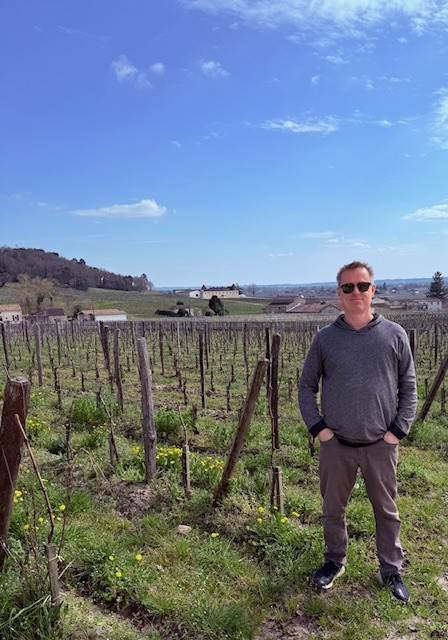
I don’t know that I can properly describe the feeling you have as you stand in the vineyards. Better still if you have a glass of wine in hand. I experienced a sense of timelessness and respect for the incredible talent of the winemakers. Everyone was incredibly kind, humble and eager to share a story. The knowledge that has been passed down from generation to generation is present everywhere you turn. I was blown away with all the stories and unique history of this region. As an American, it was also duly noted that the timeline is simply miles longer and full of twists and turns, war and peace, setbacks and overcoming them. And of course, as far as you can see in every direction, grapevines grow along beautiful rolling hills. The hills are an important part of the fields. It allows for the ebb & flow of constantly changing weather and helps keep the vineyards well drained.
Saint-Emilion is the ultimate historic medieval town. It’s full of charm, cafes and of course many different wine options. We were also able to visit the Monolithic Church from the early 12th century. With a soaring 53-meter-high bell tower and a subterranean cave with a maze of tunnels that include vast catacombs this is truly a site to see. It’s a striking piece of architecture and stunning centerpiece to a city that endures. From the Middle Ages until today, its narrow cobblestone roads lead to a stunning view around every corner. When you are in Bordeaux, don’t miss this extraordinary day trip.


