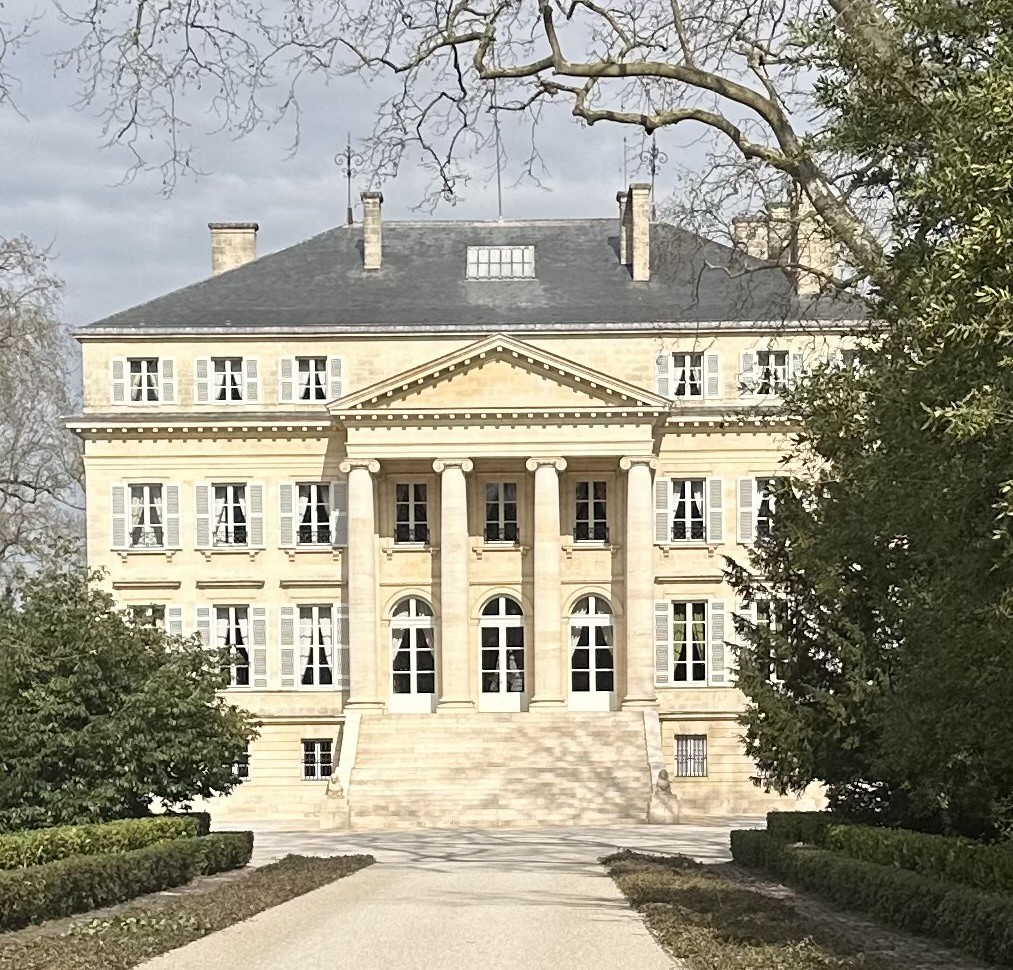

You’ve probably heard of Chateau Margaux, Chateau Lafite-Rothschild, Chateau Latour, Chateau Mouton Rothschild, and Chateau Haut-Brion. These are of course the famous “First Growths” of Bordeaux. They are undoubtedly the most prestigious wines from the Medoc and Graves regions and were defined back in 1855. These wineries produce some of the most expensive and sought after wines in the world. Prices vary wildly based on vintage and estate but you can easily expect to pay hundreds to thousands of dollars, per bottle, for these prestigious wines. Welcome to the famous Left Bank of Bordeaux! 🙂
If you believe fairy tales do exist this is probably the place to find them. Oh, you’d like a bottle of the 2010 Chateau Mouton Rothschild? That’ll be $1,375. Enjoy and come again! You can thank or curse Emperor Napoleon III for these rankings, designations and prices! The Left Bank is Cabernet Sauvignon dominant. Big, bold reds with firm tannins that age ever so gracefully. These First Growths are known to be the finest French wines you can find. If you can afford them that is. I can’t. I’m happy to step across the street and find a nice $50 bottle.
What is it about the Left Bank? And wait, which is the Left? If I turn around isn’t the left now the right and the right now the left? Let me try to explain, I know it can get confusing. All river systems flow to the sea. They don’t flow inland. When determining which is left and which is right you need to soar like an eagle with the flowing river and everything is now perfectly aligned. I recently was driving through Colorado and came across the Continental Divide. The Divide extends from Alaska to the southern tip of South America. It basically determines which direction the rivers flow. One side flows out to the Pacific and the other side flows to the Gulf, Atlantic and Artic. Remember to soar like an eagle to determine right and left. 🙂 Does that help?
Something else to consider, the Left Bank soil is gravelly. It’s not as hilly as the right bank but still has excellent drainage due to the top level gravel nature of the terroir. This suits the Cabernet grape very well. It is a hardy vine that knows how to dig deep for moisture. This also gives firm tannins and age-worthy wines. It’s not uncommon for Bordeaux Cab blends from this region to age decades before they reach their peak.
It was while touring & tasting in Medoc I learned about Phylloxera. It’s pronounced ‘fil-LOX-er-uh’. I had heard about American rootstock before but didn’t realize the significance of it all until our amazing tour guide described it in great detail. Back in the 1860s the French were experimenting with native American vines and didn’t realize that a very troubling pest, Phylloxera, took a ride from the US and ended up in the fields in France. Phylloxera is a tiny bug that attacks the grapes roots and kills them. It was so devastating that it almost killed the entire industry.
Between 1860 and 1880 it rapidly spread across France and Europe, destroying the grapevines. The ultimate irony, American rootstock is naturally immune. The Europeans were able to graft the American roots onto native European vines thus saving the entire industry. And as wild as it may seem, all 720 million vines in Bordeaux alone have American rootstock. In fact, almost every grapevine in the world has American roots. It’s just a fun trivia question now but back in the 1800s it was just one of the many obstacles the industry had to overcome.
We were lucky enough to taste Chateau Dauzac and Chateau Lamothe-Bergeron. Both were excellent. At Chateau Lamothe-Bergeron they started the tasting by taking us out into the vineyard and we were able to taste both the Merlot and Cabernet Sauvignon grapes. The tannins were very distinct in the Cab and the beautiful fruits highlighted the Merlot. It was clear how the two blended together make such a beautiful bottle of bordeaux! Once again, the incredible wine knowledge and eagerness of the wineries to show & taste their wines was memorable. A huge shout out and thank you to everyone who hosted and spent time making us more knowledgeable along the way!
I can’t believe I’ve made it this far without mentioning RULES. Have you ever wondered why so many amazing French winemakers have moved to other parts of the world and are doing incredible winemaking outside of France? This is why. There are so many rules that have to be followed when making wine in Bordeaux. I think the most common phrase from our tour guide was “it’s forbidden”! It’s forbidden to water the vines. It’s forbidden to grow anything other than the Noble varietals. For reds that’s Cabernet Sauvignon, Malbec, Merlot, Cab Franc and Petite Verdot. They have since relaxed it a bit to allow Carmenere. But that’s it. Want to call yourself a Chateau? You must grow the grapes onsite, make the wine onsite and bottle onsite for that designation. Planting density, yield limits, labeling requirements all are highly regulated. But it works. This region consistently makes some of the best wines in the world century after century, just follow the rules!
After experiencing beautiful wine tasting trips on both the Right and Left banks of Bordeaux I’m left with just ahh and appreciation for the region. Keep in mind I lived in California for 12 years and went wine tasting every couple of months! It remains one of my favorite weekend getaways of all time. But Bordeaux is different. You can sense the steep history all around you. You just have to experience it, in person. You just have to put your feet down on the land that numerous wars were fought over and where countless generations passed down the winemaking skills. It’s an extraordinary experience. Would I recommend wine tasting in Bordeaux? Absolutely yes. It’s worth the long journey, it’s worth the expense, it’s an experience you will never forget. Just go do it and let me know how it changed you!


